
Written By Janne Lee
The Essential Step: Why You Must Scour Your Fabric Before Botanical Printing
In botanical printing and natural dyeing, the success of your project hinges on proper preparation. One of the most important yet often overlooked steps is scouring—a thorough cleaning of your fabric using a natural detergent and soda ash. This process is essential to ensure the best possible results in your prints, from vibrant colors to well-defined patterns.
What is Scouring?
Scouring involves cleaning fabric to remove any substances that might interfere with dyeing or printing. These impurities include:
Manufacturing residues like oils, waxes, or sizing (used to stiffen fabric during production).
Natural oils or lanolin in plant-based or animal fibers.
Dirt, dust, and detergent residues from prior use.
By cleaning the fibers deeply, scouring creates a receptive surface, allowing plant pigments to bond more effectively during botanical printing.
The Importance of Scouring
1. Removes Barriers to Dyeing
Un-scoured fabric often has a residue layer that blocks the absorption of dyes and plant pigments. This can lead to uneven coloring or prints that lack clarity and depth. Scouring eliminates these barriers, opening the fibers to interact fully with the dye or print material.
2. Prepares the Fabric for Mordanting
Mordants (such as aluminum sulfate or ferrous sulfate) play a crucial role in botanical printing, binding plant pigments to the fabric. However, they cannot adhere effectively if the fabric isn’t properly cleaned. Scouring ensures the fabric is free of oils and residues, so the mordant can do its job.
3. Ensures Even Color and Prints
Residues on fabric can cause blotchy, streaky, or uneven prints. Scouring helps distribute pigments uniformly, resulting in consistent and professional-looking designs.
How to Scour Your Fabric
The scouring process is simple but requires attention to detail. Here’s how to do it:
Materials You’ll Need
Natural detergent: Choose a detergent free of synthetic fragrances or softeners.
Soda ash: A mild alkaline substance that helps remove oils and residues.
Large pot: Big enough to allow your fabric to move freely.
Water: Enough to fully submerge the fabric.
Step-by-Step Process
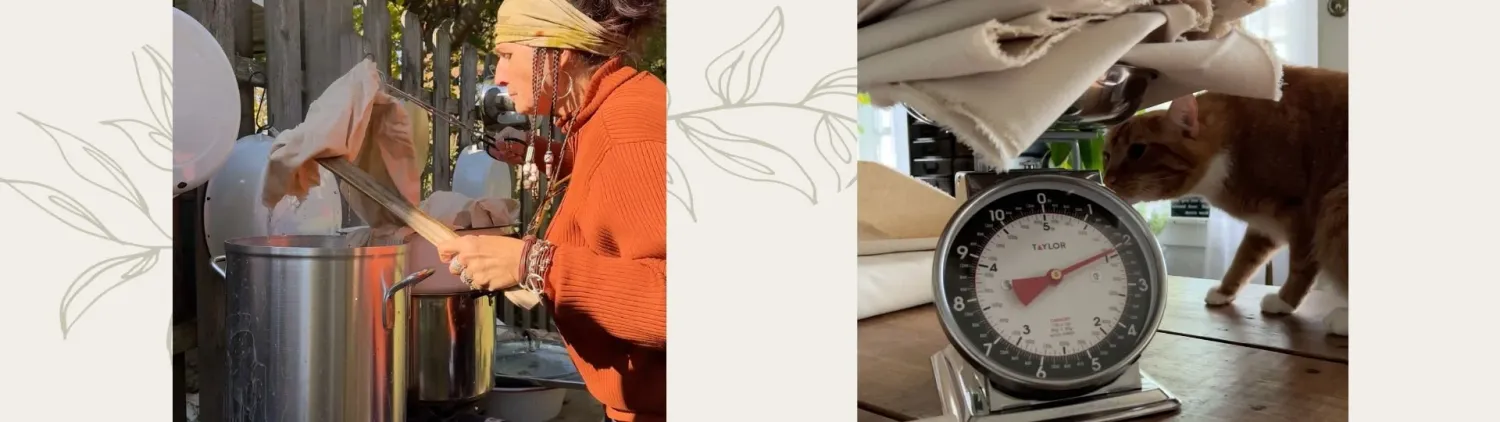
Weigh Your Fabric
Measure the weight of the fabric (WOF) (dry) to calculate the amount of detergent and soda ash you’ll need.Prepare the Scouring Solution
Fill a large pot or basin with hot water.
Add 1-2% (WOF) of natural detergent and 1% (WOF) of soda ash. Stir to dissolve.
3. Add the Fabric
Place the fabric in the solution, ensuring it’s fully submerged.
Allow plenty of room for the fabric to move freely to prevent uneven cleaning.
4. Heat and Stir
Heat the water to just below boiling (for cotton or linen) or keep it warm for delicate fibers like silk or wool.
Stir occasionally for 30-60 minutes to ensure the fabric is evenly exposed to the solution.
5. Rinse Thoroughly
Remove the fabric from the solution and rinse under warm water until the water runs clear.
Wring out excess water and let the fabric air dry or proceed directly to the mordanting stage.
Why Use Natural Detergent and Soda Ash?
Natural Detergent: Gentle on fibers and free of synthetic additives, it effectively removes oils and residues without leaving a chemical film.
Soda Ash: A mild alkaline cleaner that breaks down stubborn impurities, particularly on plant-based fibers like cotton and linen.
These eco-friendly cleaning agents are essential for preparing fabric for natural dyeing and botanical printing while maintaining the integrity of the material.
What Happens If You Skip Scouring?
Without scouring, your botanical printing results may suffer:
Blotchy or Uneven Prints: Residues can create barriers, leading to irregular absorption.
Weak or Faded Colors: Dyes and pigments that can’t fully bond with the fibers may wash out or fade quickly.
Wasted Materials: Un-scoured fabric may require re-dyeing, wasting both time and precious plant resources.
Special Considerations by Fabric Type
Cotton and Linen: Require thorough scouring to remove natural waxes and manufacturing sizing. Can handle hotter temperatures and soda ash solutions.
Silk and Wool: Delicate fibers need gentler scouring at lower temperatures. Use smaller amounts of detergent and soda ash to avoid damage.
Final Thoughts
Scouring is more than just a preparatory step—it’s the foundation of a successful botanical printing or natural dyeing project. By taking the time to scour your fabric with natural detergent and soda ash, you ensure your prints are vibrant, even, and durable.
Treat your fabric like a blank canvas, and it will reward you with stunning results. Whether you’re new to botanical printing or an experienced artist, make scouring a non-negotiable part of your process.
What’s your favorite fabric to use for botanical printing? Share your tips and experiences in the comments below!
**When working with botanical printing, always use pots, spoons, and all equipment exclusively for your art projects. Never reuse these items for cooking or food preparation, as the materials used in the process may leave residues that are unsafe for consumption. Keep your tools separate to ensure safety and maintain creative integrity.
Happy printing! 🌿
The Essential Step: Why You Must Scour Your Fabric Before Botanical Printing
Janne Lee
Fine Artist
Copyright © 2022 Janné Lee llc
To intertwine the beauty of nature with artistic expression, forging a path where botanical artistry meets innovation. Through
exploration, creation, and the fusion of natural elements, my mission is to inspire a profound connection between art and the
environment. My commitment lies in celebrating the harmony between artistic vision and the natural world where artistry and
nature converge.